Antillery Devlog #7
Introduction to Antillery
May 31, 2025
A look at the concept, history, and creative direction behind this artillery game with a peaceful twist
Project Overview
This proposal outlines the concept, inspiration, and creative goals behind Antillery, a senior capstone project that aims to turn the artillery game genre on its warhead.
What is Antillery?
Antillery is a satirical take on the beloved artillery game format. Inspired by the iconic "Worms" franchise created by Team17, Antillery maintains the same strategic, turn-based, destructively chaotic gameplay typical of an artillery-type game while introducing peace-oriented mechanics that border on disruptive and destructive in their own right.
In addition to the traditional arsenal of artillery, Antillery arms players with a new category of "eco-friendly" and "nonviolent" weaponry and tools, eco-friendly, restorative, or passive-aggressive, but still disruptive and impactful in battle.
Genre Classification
Antillery fits the classification of a 2D turn-based strategy game, belonging specifically to the artillery subgenre. It draws from the tradition of artillery games while building on the genre's core loop of indirect, physics-based combat within a turn-based system.
Artillery games typically involve players alternating turns to reposition units, aim and fire projectiles, and adapt to environmental variables such as wind or destructible terrain. These features create emergent gameplay scenarios that are easy for most players to pick up but have a level of strategic depth that offers extensive replayability.
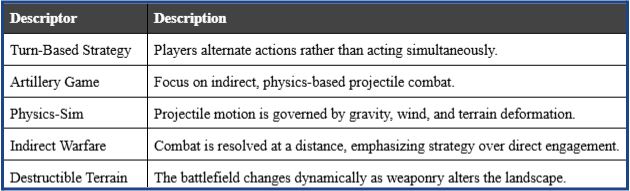
Antillery can be categorized by these genre classifications.
Historical Context
Text & Vector-Based Simulation: Origin Story
The earliest artillery games emerged as text-based simulations on mainframe computers in the 1960s. While primitive compared to today's games, these early experiments in electronic entertainment established many of the core mechanics defining the genre for decades.
The earliest simulations were developed using BASIC and were entirely text-based, requiring players to imagine the evolving battlefield. Players took turns entering parameters such as barrel angle and firing velocity.
These early simulations had a limited player base of mainframe operators who implemented and circulated their new features. Although direct visual records of mainframe-era artillery games are scarce, their design legacy persisted. By the early 1980s, successors like Artillery Duel (1983) began introducing simple vector graphics and visual interfaces on home consoles.
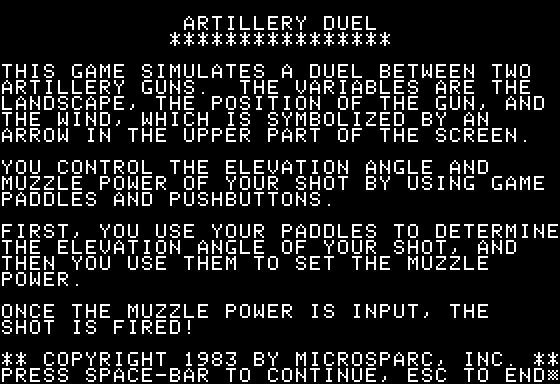
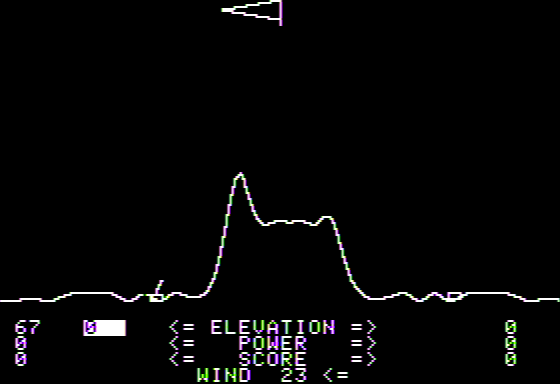
Artillery Duel (1983) brought simple vector graphics to the artillery game format (MobyGames).
Scorched Earth: The Evolution of Customization
Scorched Earth was released in 1991 and marked a pivotal moment, breathing new life into the artillery genre. Unlike its text-based predecessors, it was in full color, real-time, and standardized many of the hallmark conventions of artillery games.
Scorched Earth expanded significantly on the foundational mechanics of earlier artillery games by implementing over thirty weapons, ranging from conventional missiles to napalm. Much of its acclaim came from its level of strategic depth, afforded by its fully destructible terrain, customizable parameters such as wind and gravity, and a robust in-game economy.
This landmark artillery title introduced several design ideas that became hallmarks of the genre today. Its focus on dynamic strategy through choice and customization shaped the landscape of future artillery games.
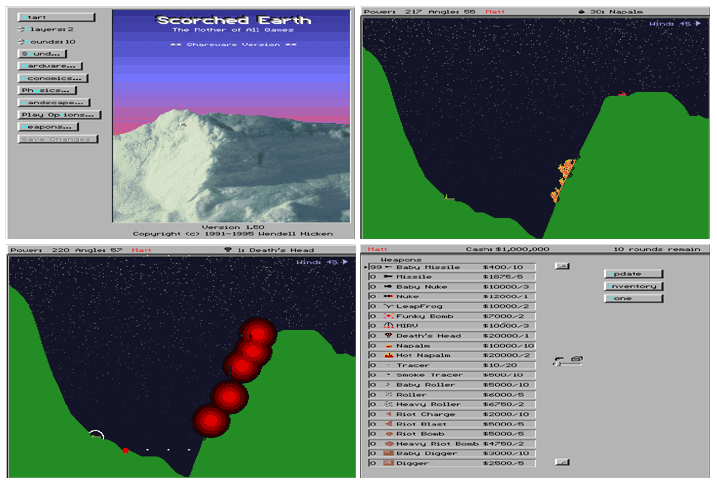
Scorched Earth (1991) UI and terrain interaction established many genre conventions (Barton).
Worms: Giving Artillery a New Backbone
Worms, released by Team17 in 1995, marked a turning point in the artillery game genre. While its gameplay preserved core projectile mechanics, its presentation shifted the genre from simulation to satirical multiplayer chaos.
Creator Andy Davidson entered the game, called initially Total Wormage, into a competition by Amiga Format magazine. Though it did not win, it caught Team17's attention, which went on to publish it across multiple platforms (Nuttall 26; Barton).
Worms emphasized player mobility, absurdity, and personality, unlike its tank-centric predecessors. Worms could walk, jump, and swing across terrain using ninja ropes and parachutes, adding momentum and physical comedy to a genre previously rooted in physics realism.
Barton observed, "The worms can do much more than tanks," describing moments of dramatic acrobatics. Its tone embraced British comedic absurdity, transforming once-serious combat into a stage for slapstick and satire.
Exploding sheep, banana bombs, and absurd weapons blurred the line between threat and punchline. Cheeky voice lines like "First blood!" and "This worm is an ex-worm!" gave the game personality and flair, establishing a new kind of identity for artillery games, one dripping in irony, theatricality, and joyful nonsense.
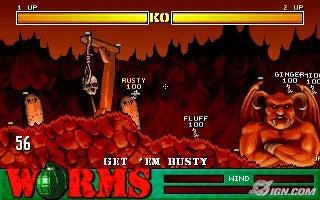
Worms (1995) featuring destructible terrain and satirical visuals that redefined the genre (LaFlame).
Artillery Genre Evolution
- 1960s: Text-based BASIC simulations on mainframes
- 1980s: Vector graphics with Artillery Duel (1983)
- 1991: Scorched Earth - color, customization, economy
- 1995: Worms - mobility, personality, satirical tone
- 2025: Antillery - peace tools alongside traditional weapons
Conceptual Context
Antillery's goal is to push the boundaries of artillery combat, drawing inspiration from Worms while evolving the genre in bold new directions.
Following Worms' Legacy of Innovation
Worms redefined artillery combat through absurdist humor and player mobility, transforming a simulation-focused genre into something entirely new. Antillery takes its lead by blending modern cultural satire with new peace-driven gameplay mechanics, honoring the spirit of innovation introduced by Worms while pushing the artillery genre into a new frontier.
The goal of Antillery is not to apply new paint to a formulaic experience but to evolve the artillery genre in the way that Worms did in its day. Just as Worms brought personality and absurdity to what was once a sterile simulation, Antillery introduces a satirical examination of conflict resolution through gameplay.
The Balance of War and Peace
Players still have access to traditional artillery weapons like bazookas and grenades. However, in Antillery, they may also employ new strategies centered on peace, love, and environmental restoration. This duality challenges players to rethink what combat can be, forcing them to balance war and peace as part of their tactical thinking.
Nevertheless, even actions of peace, love, and environmentalism sometimes create destructive outcomes. A sunflower might create a shielding canopy, an isolating barrier, or a bridge to strategic ground. In Antillery, every action, whether peaceful or aggressive, becomes part of a larger strategy shaped by the player.
Weapons & Tools
Antillery presents players with a choice between overtly destructive methods and seemingly benevolent alternatives that can achieve equally devastating results through different means. Don't be fooled by the peaceful branding, these "eco-friendly" and "nonviolent" tools can be just as devious and destructively impactful as any conventional weapon, forming the heart of Antillery's satirical commentary on conflict resolution.
War
Honest about their destructive intent, these weapons deliver straightforward damage and terrain modification.
- Conventional Explosives: Direct damage through familiar artillery projectiles
- Area Effect Weapons: Wide blast radius for strategic terrain removal
- Precision Strikes: Targeted elimination of specific threats
Peace
Marketed as environmentally conscious and nonviolent, yet capable of achieving devastating tactical advantages through creative application.
- Restorative Solutions: "Healing" the battlefield in ways that trap, isolate, or disadvantage opponents
- Passive-Aggressive Disruption: Indirect methods that can be more psychologically and strategically devastating than direct attacks
- Constructive Manipulation: Building terrain that creates kill zones, blocks escape routes, or sets elaborate traps
Gameplay Mechanics
Antillery builds upon the traditional artillery game format with distinctive mechanics that enhance strategic depth and player expression.
Core Gameplay Loop
Players control teams of ants in turn-based combat on destructible 2D terrain. Each turn follows a structured sequence:
- Movement Phase: Reposition your active ant within movement limits, navigating terrain and hazards.
- Tool Selection: Choose between traditional weapons or peace-oriented tools, each with unique tactical implications.
- Aim & Power: Set trajectory and power using intuitive angle/strength controls, factoring in environmental variables.
- Execution: Observe the results as physics-based interactions play out, altering the battlefield dynamically.
- Environmental Response: Adapt to terrain changes, wind shifts, and other evolving conditions to plan your next move.
Environmental Systems
Dynamic environmental factors create emergent gameplay situations that evolve throughout each match:
- Destructible Terrain: Terrain deforms realistically from explosions and can be rebuilt or manipulated using peace tools.
- Variable Wind: Wind direction and strength change between turns, significantly affecting projectile trajectories.
- Gravity Settings: Adjustable gravity levels allow for diverse gameplay experiences, from low-gravity lunar battles to high-gravity challenges.
- Water Hazards: Flooding in lower terrain areas introduces movement challenges and strategic opportunities.
Strategic Depth
The interplay between traditional weapons and peace tools creates a rich strategic landscape. Players must weigh their options carefully, considering:
- Current terrain configuration and team positioning
- Available tools and their specific tactical applications
- Environmental conditions like wind, gravity, and water hazards
- Long-term resource management across multiple turns and ants
Antillery's mechanics encourage creativity and adaptability, rewarding players who can think several moves ahead while responding to the unpredictable nature of the battlefield.